Some ideas are dangerous not because they are unpopular, but because history has repeatedly shown where they lead
One of those ideas is the belief that political power should be organized around religious dominance.
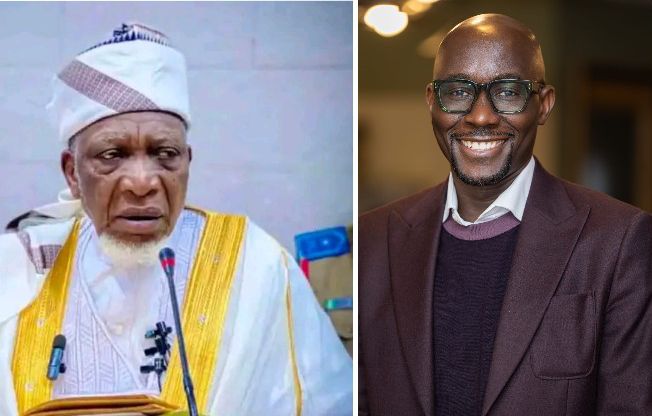
That is why the recent remarks attributed to Sheikh Yahaya Jingir deserve serious concern.
Reports indicate that the influential cleric defended the Muslim-Muslim ticket, portrayed electoral support as evidence of Muslim numerical superiority, referred to opponents as “infidels,” and suggested that
those uncomfortable with such arrangements should leave Nigeria. If accurately reported, such statements represent more than ordinary political advocacy; they reflect a troubling understanding of citizenship, democracy, and national belonging.
The question is not whether Sheikh Jingir has a constitutional right to political opinions. He does.
Every Nigerian citizen enjoys that right.
The real question is whether a religious leader should use spiritual authority in ways that encourage citizens to view politics primarily through the prism of religious identity.
My answer is simple: no.
Nigeria’s democracy was never intended to become a contest between Muslims and Christians.
Neither was it intended to become a referendum on which faith community is larger.
The idea that electoral victory demonstrates religious superiority fundamentally misunderstands
democracy. Elections are designed to determine who governs, not which religion prevails. Citizens vote to address insecurity, poverty, unemployment, corruption, inadequate infrastructure, and the rising cost of living. They do not vote to establish the dominance of one faith over another.
A Muslim-majority vote does not make Nigeria a Muslim state.
A Christian-majority vote would not make Nigeria a Christian state.
Nigeria belongs equally to all Nigerians.
That principle is non-negotiable.
That principle was understood by one of Nigeria’s most respected elder statesmen, General Yakubu Gowon, who famously declared that “the unity of Nigeria is worth preserving.” Those words were
not merely political; they were a moral affirmation that the Nigerian project must transcend ethnic, religious, and regional divisions.
National unity cannot be preserved through narratives of religious
superiority, political exclusion, or sectarian triumphalism. It can only be sustained when citizens, regardless of faith, are treated as equal stakeholders in a common national enterprise.
For those who invoke religion in the political arena, Gowon’s words carry an important lesson.
The true measure of leadership is not the ability to mobilize one’s religious constituency against others, but the ability to strengthen the bonds that hold a diverse nation together.
In a country as plural as
Nigeria, leadership that promotes coexistence is not weakness; it is wisdom. Leadership that deepens
division, however unintentionally, places at risk the very unity that generations of Nigerians have struggled to preserve.
Indeed, the most troubling aspect of the reported remarks is not support for a Muslim-Muslim ticket itself. Reasonable people can disagree about political tickets. The deeper problem is the apparent
effort to transform political preference into a marker of religious identity and communal strength.
Once politics becomes a competition for religious supremacy, fellow citizens gradually become rivals, and rivals can eventually become enemies.
History offers numerous warnings about where such thinking can lead.
Nations do not fracture overnight.
Before societies become divided, they are first persuaded that political power belongs more naturally to one group than another. Before discrimination emerges, there is rhetoric. Before exclusion
becomes policy, it becomes language. The journey from division to conflict often begins with words
that normalize the idea that some citizens belong more completely than others.
This is why influential religious leaders must be held to a higher standard.
No one can deny Sheikh Jingir’s influence. Millions respect him, listen to him, and trust him. That influence can be used to encourage moderation, mutual respect, and peaceful coexistence. It can
also be used, intentionally or otherwise, to deepen existing fault lines in a country already struggling with religious and ethnic tensions.
Leadership is measured not by the size of one’s following but by the wisdom with which that following is guided.
For those of us from Plateau State, this issue is not theoretical.
We know what happens when religious identity becomes politically weaponized.
We know what happens when citizens are encouraged to see one another not as neighbors, but as competitors in a struggle for dominance.
We have seen communities divided by suspicion.
We have witnessed cycles of violence fueled by narratives of exclusion and superiority.
We have buried mothers, fathers, children, and neighbors whose lives were cut short because the bonds of shared citizenship were weakened by the politics of identity.
The graves scattered across Plateau are powerful reminders that words matter.
That is why rhetoric that suggests religious ownership of political power should alarm every patriotic
Nigerian, regardless of faith.
Ironically, this form of politics ultimately betrays the very people it claims to defend.
The ordinary Muslim struggling to feed his family gains nothing from religious triumphalism.
The ordinary Christian struggling to pay school fees gains nothing from sectarian politics.
The farmer threatened by insecurity, the trader affected by inflation, the unemployed graduate
searching for opportunity, and the widow seeking justice all confront the same realities.
Their problems are not religious.
Their problems are governance problems.
The task before Nigeria is therefore not to determine which religion is politically stronger. It is to determine how to build a nation where every citizen enjoys equal dignity, equal protection, and equal opportunity under the law.
That is the true test of leadership.
Religious leaders perform their highest service not when they mobilize followers for political advantage but when they speak courageously for justice, accountability, peace, and the common
good. Their role is not to deepen divisions but to remind society of its shared moral obligations.
Sheikh Yahaya Jingir possesses a platform capable of advancing those values.
The tragedy of his reported remarks is that they move in the opposite direction.
As a son of Plateau State, I write from a place shaped by both the promise of diversity and the pain of division. I have witnessed the devastating consequences of ethno-religious conflict on
communities that once lived together in peace. I have seen how mistrust spreads, how reckless rhetoric inflames tensions, and how ordinary families ultimately bear the cost of leadership failures.
My motivation in writing is neither partisan nor sectarian. It is rooted in a conviction that Nigeria’s future depends on our ability to resist every attempt to transform religious identity into a political
weapon. The concerns raised in this article are not directed against Islam, nor against Muslims, just as they would not be directed against Christianity or Christians if the circumstances were reversed. They
arise from a belief that no faith should be used to advance narratives of political entitlement, exclusion, or superiority.
The lesson Plateau State has repeatedly taught us is that societies are strongest when leaders build bridges rather than deepen divisions. Those who command large religious followings possess
immense power to shape public attitudes. With that power comes an obligation to exercise restraint, promote mutual respect, and defend the equal dignity of every citizen.
Nigeria does not need religious majoritarianism.
It does not need clerics measuring political success by the dominance of one faith community over another.
It does not need language that encourages citizens to see themselves as owners and others as outsiders.
What Nigeria needs is a renewed commitment to equal citizenship.
What Plateau State needs is greater interfaith trust.
What our future demands is leadership that builds bridges rather than boundaries.
The most consequential figures in history are remembered not because they rallied their communities against others, but because they helped their communities live with others.
That is the choice before Sheikh Yahaya Jingir.
And that is the choice before Nigeria.
About the Author
Dr. Barth Shepkong is the National President of the Plateau State Association, USA (PSA-USA). He writes frequently on issues of Public Policy, peacebuilding, democratic governance, religious
pluralism, conflict prevention, and social justice. As a son of Plateau State, he is committed to fostering interfaith understanding, strengthening democratic values, and advancing peaceful coexistence among all communities. The views expressed herein are solely those of the author and are offered in the interest of peace, justice, democratic accountability, interfaith understanding, and the pursuit of a more united and peaceful Plateau State and Nigeria.
count | 44

Recent Comments
Rinret JackdenSeptember 5, 2026 at 2:27 pm
Mwanchuel Daniel PamMarch 8, 2024 at 11:06 pm
Bob WayasNovember 6, 2023 at 5:30 am