
Emancipate Yourself from Mental Slavery: Dismantling Publishing Imperialism in African Academia”
Emancipate yourselves from mental slavery, none but ourselves can free our minds.” Bob Marley’s timeless call to action offers a vital framework for diagnosing the structural crisis currently crippling African higher education.
At its core, the subjugation of African scholarship to foreign commercial matrices is a manifestation of epistemic injustice;specifically testimonial and hermeneutical injustice, wherein the knowledge produced by scholars in the Global North is automatically privileged, while African ways of knowing, local priorities, and contextual realities are systematically discredited or rendered invisible.
Epistemic injustice occurs when commercial publishing platforms and Western-centric indexing systems act as gatekeepers of legitimacy, deciding whose knowledge counts, who is deemed credible, and which research questions deserve to be asked.
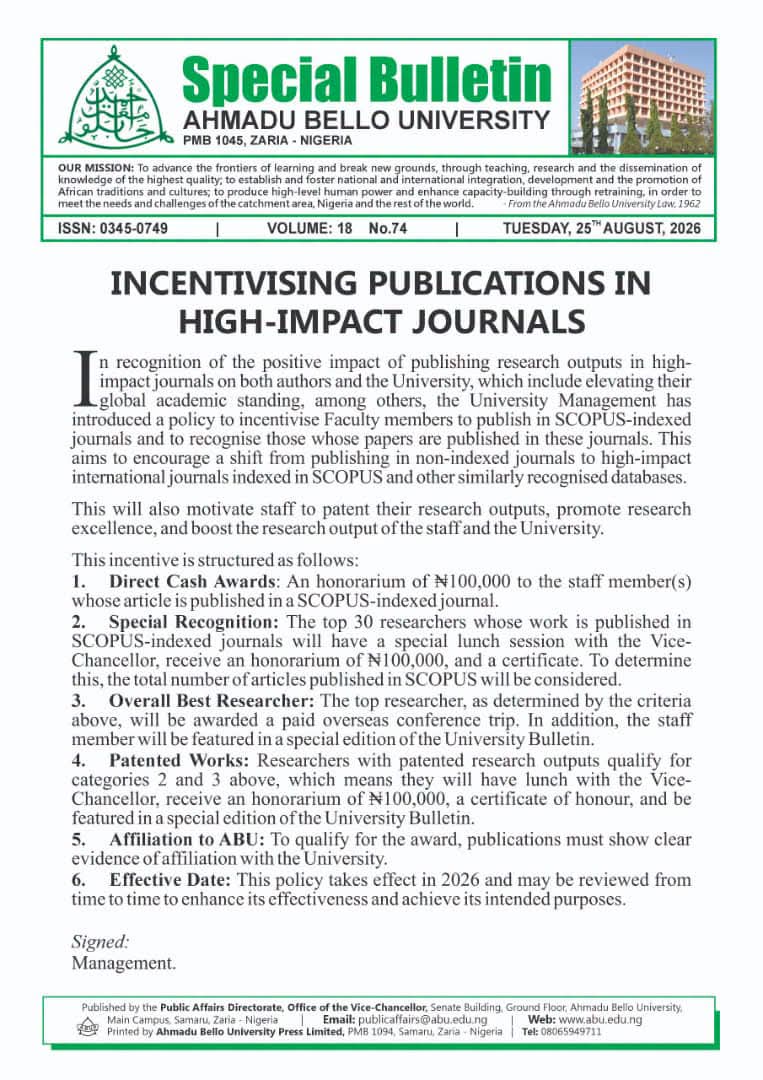
The Ahmadu Bello University (ABU) bulletin serves as empirical proof of how global commercial publishing interests have successfully captured African university governance. By offering direct cash awards (₦100,000) and institutional privileges for SCOPUS-indexed publications, ABU is effectively outsourcing its academic standards to private multinational corporations.
Instead of deploying scarce university resources to fund local laboratories, sponsor regional field research, or build indigenous publishing infrastructure, public funds are being used to incentivize scholars to hand their intellectual property over to Northern publishing conglomerates.
By submitting to these foreign standards of academic worth, African universities internalize their own marginalization.The hyper-fixation on high-indexed, Western-dominated databases like Scopus and Web of Science distorts the true mission of African higher education.
Major commercial publishers such as Elsevier and Taylor & Francis operate an extractive business model that exploits the global academic system, and African institutions in particular. By locking publicly funded research behind astronomical library subscription paywalls or demanding exorbitant Article Processing Charges (APCs) often reaching thousands of dollars for “Gold Open Access,” these corporate conglomerates monetize intellectual labor they neither create nor pay to review.
African universities, burdened by systemic underfunding and unfavorable currency exchange rates, are effectively priced out twice: first, when their cash-strapped libraries cannot afford access to the global repository of knowledge, and second, when their scholars cannot afford the APCs required to publish in these supposedly “prestigious” spaces. This economic gatekeeping reinforces epistemic dependency, converting African higher education into a captive consumer market for Western publishing monopolies while siphoning scarce local institutional funds into foreign corporate profits.
Crucially, this metric-driven academic mentality; tying institutional promotion, tenure, and grants exclusively to high-impact factor journals forces African academics to prioritize foreign research agendas over local community needs. Because top-tier Western editorial boards favor topics that appeal to global market interests or Western theoretical frameworks, African researchers are systematically disincentivized from tackling immediate, hyper-local challenges, such as regional public health, indigenous knowledge systems, local environmental degradation, or grassroots political reform.
Research targeting a specific local community is routinely rejected by high-indexed journals as “too context-specific” or lacking “broad international appeal.” Consequently, vital indigenous research is marginalized or forced into under funded local journals that university reward systems dismiss as inferior.
By outsourcing academic validation to commercial entities in the Global North, African universities alienate their own scholars from the immediate social realities of their societies, ensuring that academic output serves global ranking metrics rather than local human development.If African higher education continues to allow neoliberal scholars and market-driven metrics to dictate university governance and intellectual agendas, authentic local development will remain entirely out of reach. Neoliberalism treats education as a commodity and research as a transaction, forcing universities to act like corporations competing for arbitrary international rankings rather than engines for local transformation. Under this trajectory, African institutions will only continue to produce derivative scholarship that serves foreign theoretical markets while neglecting the urgent socio-economic and cultural needs of their own communities.
True intellectual liberation and sustainable growth require dismantling this foreign market dependency, reclaiming African-centered research agendas, and valuing knowledge based on its transformative impact on local lives rather than its citation index in corporate databases.
Dakwom Makpring Longgul
Lecturer, Department of Theatre and Film Arts, University of Jos
count | 12


