Dakwom Longgul reports from Abuja
Veteran labour leader and columnist, Comrade Owei Lakemfa, has warned that the ongoing push for the creation of state police will not fundamentally alter the partisan nature of electoral policing in Nigeria, arguing that the institutional rot within the Nigeria Police Force and the overwhelming dominance of the ruling party across state governments make meaningful reform unlikely before the January 16, 2027 presidential election.
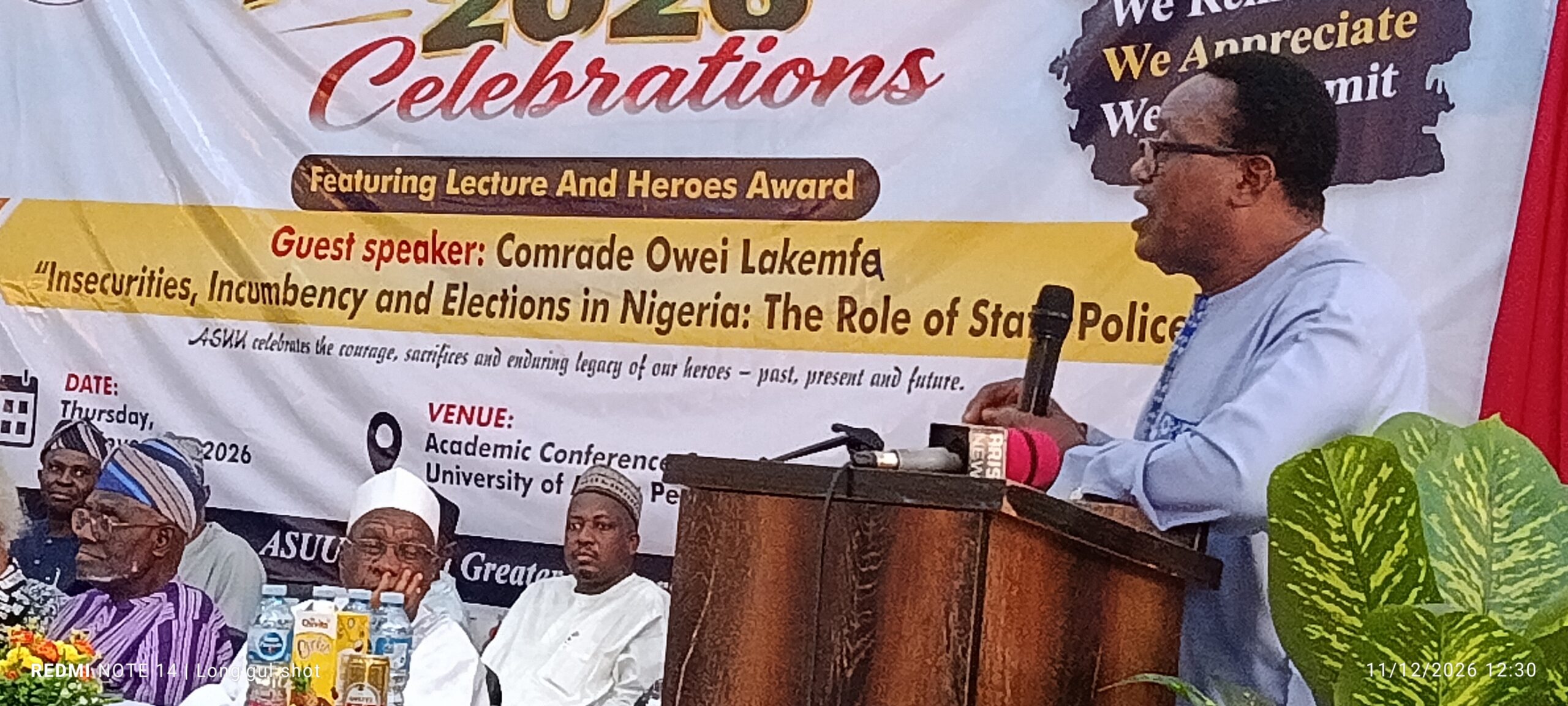
Delivering the keynote lecture at the 2026 Academic Staff Union of Universities (ASUU) Heroes’ Day celebration, themed “Insecurity, Incumbency and Elections in Nigeria: The Role of State Police”, Lakemfa traced a grim historical arc from the 1979 constitutional debates to the Fourth Republic, illustrating how the power of incumbency has repeatedly subverted democratic accountability.
With the January 2027 polls roughly nine weeks away, the former General Secretary of the Organisation of African Trade Union Unity (OATUU) dismissed expectations that state policing structures could be established and operationalised in time to safeguard the ballot.
“For me, it is unlikely that state police will be in place before then,” Lakemfa told an audience of academics, union veterans and pro-democracy activists.
“But even if you have state police, with 32 state governors inside the ruling party and none of the two main opposition parties having a single governor, no fundamental changes to electoral policing will take place. Whether you have state police or not will not make a fundamental difference. The Nigeria Police Force is not about to be reformed, and policing in the 2027 presidential elections is likely to follow the old partisan pattern.”
Drawing from decades of political history, Lakemfa argued that Nigerian leaders have historically viewed electoral victories not as a mandate for service, but as a birthright to be defended at all costs.
He recalled the controversial 1979 Supreme Court interpretation of “two-thirds of 19 states” that handed Shehu Shagari the presidency, noting that by 1983, the ruling National Party of Nigeria (NPN) “had gone nuclear” in securing a landslide victory, a move that sparked widespread violence and precipitated the military coup that ended the Second Republic three months later.
According to Lakemfa, that culture of entitlement survived into the Fourth Republic. He noted how former President Olusegun Obasanjo sought a second term and subsequently an aborted third term, despite unfulfilled promises, and how former President Goodluck Jonathan similarly felt entitled to a fresh mandate after completing the tenure of the late Umaru Musa Yar’Adua. Turning to the current administration, Lakemfa observed that the “Emi lo kan” (“It is my turn”) philosophy that ushered in the presidency four years ago is now giving way to a familiar cycle of recycled campaign promises ahead of 2027.
The annual Heroes’ Day event which honours fallen and living icons of the union, including the late Dr Mahmud Tukur, Festus Iyayi, Biodun Jeyifo and Bene Madunagu also served as a platform for Lakemfa to extol ASUU’s internal democracy and historical sacrifice.
Recounting his decades-long solidarity with the union since the early 1980s, Lakemfa described ASUU as “the best labour organisation on the African continent”, uniquely insulated from state capture because it mandates secret-ballot referendums among its members before declaring or suspending any industrial action.
He reminded the gathering that following the July 29, 1975 military coup led by Generals Murtala Muhammed and Olusegun Obasanjo which purged the armed forces, dismantled civil service security, crushed the labour movement and cowed the judiciary university lecturers remained the sole organised voice of resistance.
From defying the Industrial Arbitration Panel’s back-to-work orders under Biodun Jeyifo to mediating student crises during the 1981 University of Ife killings and the 1986 Ahmadu Bello University (ABU) murders, ASUU, he said, has consistently stood “between Nigerian universities and total decay,” midwifing critical interventions such as the Tertiary Education Trust Fund (TETFund).
Earlier in his welcome remarks, the ASUU leadership paid glowing tributes to the union’s past presidents and elder statesmen in attendance, including Comrades Ukachukwu Awuzie, Nasir Isa Fagge and Emmanuel Osodeke, alongside Board of Trustees member Professor Assisi Asobie.
The event drew high-level representation from the nation’s university administration and regulatory bodies, including the Executive Secretary of the National Universities Commission (NUC), Professor Ribadu, his predecessor Professor Munzali Jibril, and several Vice-Chancellors from institutions including Bayero University, Kano (BUK), Ahmadu Bello University (ABU), and the Federal University of Petroleum Resources, Effurun (FUPRE). Distinguished Senator Shehu Sani, Barrister Femi Falana, and family members of the late Dr Mahmud Tukur—whose converted doctoral thesis was slated for public presentation at the close of the ceremony, were also honoured at the gathering.
count | 12


